This year in KBI (Kaleo Bible Institute), we are studying the book of Exodus. One of the key things we are trying to grasp is the importance of the book of Exodus in the New Testament. The truth is, its importance probably cannot be overstated. Not only was the exodus a life-changing event for those who were freed from slavery, it became an interpretaive reality for future generations. To say it simply, Israel was formed by the exodus.
Exodus 34
When most people think of the book of Exodus, they probably think about the Passover, the golden calf incident, and the tabernacle. However, I would argue that Exodus 34 is just as important in understanding who God is. Earlier in Exodus 3, God reveals himself to Moses as from the burning bush as the “I AM.” In Exodus 34, Moses goes back up a mountain to receive the law again, for the second time (this was due to Moses’ breaking the tablets because of Israel’s idolatry of the golden calf). In one of the most quoted texts in the rest of the Bible, Exodus 34:6-7, God further reveals himself to Moses:
“The LORD passed before him and proclaimed, ‘The LORD, the LORD, a God merciful and gracious, slow to anger, and abounding in steadfast love and faithfulness, keeping steadfast love for thousands, forgiving iniquity and transgression and sin, but who will by no means clear the guilty, visiting the iniquity of the fathers on the children andthe children’s children, to the third and the fourth generation.’”
After such an in-depth revelation of God’s character, Moses is changed. As he comes down the mountain, Israel notices that Moses’ face is shining, reflecting the glory of God (Ex. 34:29-33).
The Transfiguration
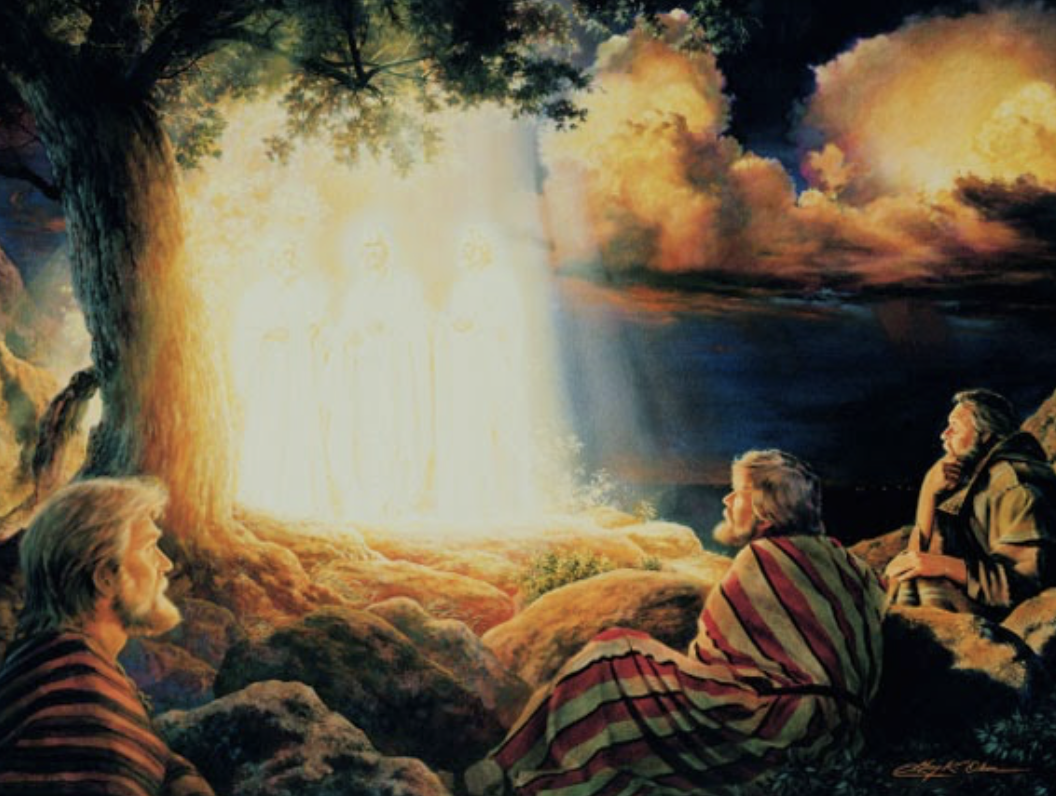
Years later, the True and Greater Moses takes his three closest disciples up a mountain. In a stunning moment, Moses and Elijah are present with Jesus and his disciples. What is fascinating is that Luke uses a particular word to alert his readers to what is actually happening. He writes this in Luke 9:30-31:
“And behold, two men were talking with him, Moses and Elijah, who appeared in glory and spoke of his departure, which he was about to accomplish at Jerusalem.”
The reason this is fascinating is that when Luke speaks of Jesus’ “departure,” the Greek word used is actually “exodus” (ἔξοδος). Why is Luke doing that? The previous passage in Luke is Jesus telling his disciples that he must die and suffer many things (Luke 9:21-22). Luke sees Jesus as the True Passover Lamb, who would shed his blood to set his people free from their slavery to sin.
Within this context, the shining face of Moses is also meant to be in our minds as we approach the Transfiguration of Jesus. Why? If we look at Matthew’s account of what happened on that mountain, we see something similar and dissimilar. Matthew 17:2 tells us this about Jesus:
“And he was transfigured before them, and his face shone like the sun, and his clothes became white as light.”
What is similar is that on this mountain, reminiscent of the mountain Moses was on, Jesus’ face shines with the glory of God. What is dissimilar is that Moses’ face shone as a reflection of the glory of God, whereas Jesus’ face shines as the source of the glory of God. The glorious brightness of the face of the Son is front and center in his own self-revelation. If that were not enough, the thunderous voice that spoke from heaven at Jesus’ baptism speaks again. Matthew records this and writes in 17:5, “This is my beloved Son, with whom I am well-pleased. Listen to him!“
The Source of all beauty, glory, and light can transform us just like he transformed Moses (2 Cor. 3:16-18). The one greater than Moses and Elijah speaks, and we would do well to listen. He is the final revelation of God (Heb. 1:1-3).
 Old Testament Allusions