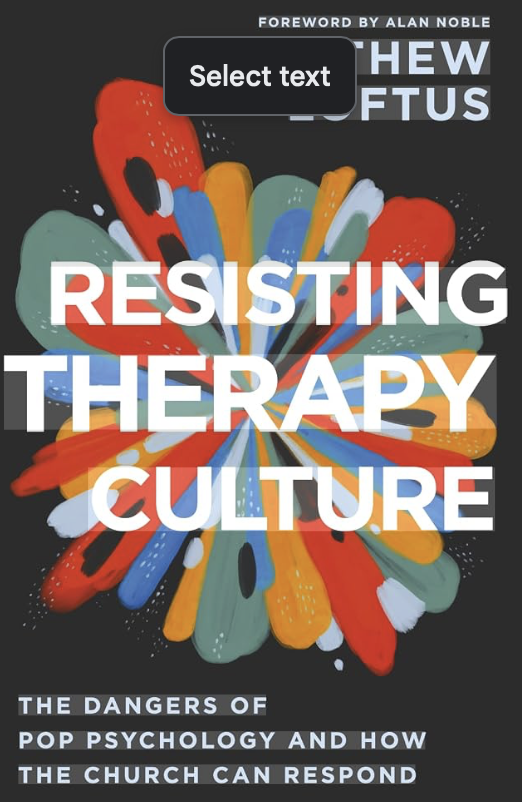
It is not often that a book comes out that leads me to continuously walk across the house to read long portions to my wife. About a decade ago, I was first asked the question, “Pastor, are you trauma-informed?” At the time, I internally began wrestling with whether or not I should give a detailed account of my experience with war, PTSD, and the reverberating images that play in my head 20+ years later. As a pastor, I’ve wrestled with the frequency of words like trauma, anxiety, and PTSD in the church. I understand that these words are sometimes thrown around light-heartedly, but my concern has been less about those examples and more about the regularity church members use them as identity markers. Even more concerning has been the use of those words more regularly than biblical words like gospel, justification, propitiation, etc.
What is Therapy Culture?
Matthew Loftus has some of the same concerns that I have had. To be clear, Loftus does not think therapy is bad or evil. What his book does well is to nuance the differences between therapy and therapy culture. In fact, he makes very clear that he is “a family physician and medical missionary who has spent a great deal of his career helping people in rural Africa who don’t have access to psychotherapy and psychiatric medications to obtain them” (p. 9). His book is more “concerned about therapy culture and the church” (p. 8).
So, what is therapy culture? Matthew has a three-pronged foundation for understanding the main tenets of therapy culture. He writes, “It consists of the medicalization of normal emotional and spiritual experience, the judgment of all activities by their perceived impact on mental health, and the loss of agency that is induced by the first two components and then aggravates them in turn” (p. 3). The book looks at these three components, their overlap, and how things like suffering, mental illness, parenting, trauma, and addiction are addressed by proponents of therapy culture. To be upfront, I would like to share about one-hundred quotes, but I think you should buy the book and read it for yourself. However, Loftus does not mince his critiques of therapy culture, but he is incredibly balanced and thoughtful in walking through all of these different topics.
Why Therapy Culture is so Dangerous for the Church
After my time in the Army, I was eventually diagnosed with Post-Traumatic Stress Disorder (PTSD), Major Depressive Disorder (MDD), and Social Anxiety Disorder (SAD). The difference between how the church helps people like me and how therapy culture treats people like me is a massive chasm. For example, the church might counsel me when I am tempted to isolate that Jesus experienced intense trauma on the cross so that I would know I wasn’t alone. The Bible might remind me that I am called into a redeemed community to listen to my fears and anxieties, but then know that my fellow church members could help me cast my anxieties upon Jesus because he cares for me (1 Pet. 5:7).
Therapy Culture, which I would argue is most learned and believed through social media, might encourage me to dive deeper into self-care. If I need to be alone for weeks on end, that is what is best for me. I might be quickly prescribed a medication, rather than a path to health through regular disciplines like eating well, exercising, and talking about my issues with friends, a pastor, or a therapist. Loftus does show that “the broader culture of therapy-speak has gotten so far ahead of the clinical world that the two are now frequently conflicting with each other as well” (p. 11). One of the terrifying fruits of therapy culture is that a person can watch 10 minutes of Instagram reels, their algorithm gets set, and they self-diagnose themself to have anxiety and trauma. These self-diagnosed identities threaten to replace God-given identities like being in Christ, holy, and a child of God.
The biggest danger, in my opinion, is when people have a misplaced hope in psychology. Please don’t misunderstand me; I don’t believe therapy is bad. I spent a year straight in therapy to deal with issues that I needed a specialist for. But the gospel was the main news that continued to heal me, even though therapy was an incredible help. My fear is that the main means of grace God has given his people to overcome the temptations, sins, and sorrows of this world is being replaced by therapy-culture jargon. The good news of Christ’s perfect life, death, and resurrection is being traded for the culture’s means of growth through self-care, self-diagnosis, and a victim mentality. The author shares my concerns when he writes, “Therapy culture promises a secular form of salvation, drawing on the authority of psychiatric medicine to displace authorities like the church. Many lives have been ruined over the years as people sought to self-actualize and only ended up with a bunch of broken relationships. Even Christians who look to ‘Jesus plus therapy’ can find themselves led astray” (p. 95-96).
Loftus helpfully writes in his chapter on trauma, “Pastors and their churches will undoubtedly encounter people who are suffering from the lingering experience of trauma. A basic understanding of what we can (or can’t) say for sure about trauma and PTSD is invaluable for Christians who are trying to tell people about Jesus and the unimaginable trauma he experienced so that we could be reconciled to God” (p. 150). This is what the broken and sorrowful soul needs above all else.
Highlights
I’m not sure I’ve underlined, highlighted, and written notes this much in a book in quite a while. What that told me was that this topic matters. I’ve experienced the bad fruit of church members who have given more authority to therapy culture than they have to the gospel and the Scriptures. I would highly recommend this book as a whole, but the chapters I highlighted most are the chapters on Diagnoses and Treatments, Suffering and Mental Illness, and Trauma.
As someone who has often felt alone in my experiences of war and the memories that remain, my favorite quote that I highlighted and thought about most often since finishing the book is found on pages 164-165, when he writes, “The nature of trauma perhaps best illustrates the key distinctions about what it means for the Church to be the Church amid a therapeutic culture. Your local church is not a place where people go to be healed of their PTSD because the local church is not an institution designed to fix people’s problems. The Church carries on the healing work of Christ, but the degree to which it is “trauma-informed” is really just a question of whether it is a place where people who are suffering are cared for in ways that treat them as beloved children of God. A pastor may counsel someone who is suffering from PTSD and refer that person on to someone who is trained in specific therapies for treating PTSD, but he can also help that person experience reintegration and joy. A church that worships God and preaches the gospel can be a place of solace and hope for people who are suffering from PTSD because it is a community that welcomes people and helps them feel safe.“
As a pastor who suffers from PTSD but also believes that a gospel-centered church family embodies something far more powerful than therapy culture, my hope is that this book serves as a warning, a course correction, and hope for those who are desperate to taste and see that the Lord is good (Psalm. 34:8). The conclusion of the book titled The Good Enough Church is worth the price of the book alone. Amongst many promising paths through therapy culture, Matthew Loftus lists 5 principles that make our churches “good enough” when it comes to being places of comfort and healing for those with mental health issues. Those 5 principles are:
- A good enough church exists to worship God, celebrate the sacraments, and preach the Word
- A good enough church doesn’t exist to fix people’s problems.
- A good enough church is a place where leaders and others live in healthy cycles of stress and rest.
- A good enough church is a place where people mourn and lament together.
- A good enough church doesn’t have a steady stream of wounded people limping out.
I’m incredibly thankful and indebted to Matthew for writing this book. It gave language, research, and hope for a concern I’d been carrying for a decade. If you are interested in reading the book, you can buy it here: https://www.amazon.com/Resisting-Therapy-Culture-Dangers-Psychology/dp/1514012685/ref=sr_1_1?crid=2UHKL5NVES9YN&dib=eyJ2IjoiMSJ9.1a8Pw9Z-LSD3b8ilZR_bY7DtkOV_sX6RJl2ihFOMTzZEo1WIpaaiVg2–Gy8rKUS8dE5iUOxDYtcvnHBX5OQldymH1WfcldMQsLGyd8B3Jw83zcgPIfXH4mwr9b2ehkfG9jQpKnR1SVRqcuJVPjt3n21729E891gYQi4OlemKdoBE6pXkvrtizHeEJyL-q1ZfaKA8P90CfigNJSzBG7ThnYqcKFRUhqkVjlbo0YwuJE.jwKMOTxMm64L3zK4zbwY90sJWrd-9hQaOzb-6x4GYGg&dib_tag=se&keywords=matthew+loftus+resisting+therapy+culture&qid=1790100751&sprefix=Matthew+Loft%2Caps%2C208&sr=8-1

